We have been providing excellent customer service for over 19 years and you are the reason we are still in business!Please call ahead and come by to visit us at one of our convenient locations in Durham, Hillsborough, or Roxboro! You are our top priority!
"It's not finding the right car what really matters anymore, it's finding the right Dealer". Welcome to CBS Quality Cars Mitsubishi
The Honda Accord has continued its reign as the used car pulling in the most online traffic for Kelley Blue Book, and though there were some moves on the list, much of the 25 most-researched used vehicles on KBB.com this month held steady from December.
Same as last month, the Honda Accord and Honda Civic took spots one and two, respectively, and were followed by the Toyota Camry (No. 3), Ford F-150 (No.4) and Toyota Corolla (No. 5).
The Chevrolet Silverado 1500, which was No. 8 in December, moved up to sixth this month. It switched places with the Nissan Altima. Placing seventh again was the BMW 3 Series.
Also swapping spots were the Ford F-250/F-350/F-450 Super Duty (moving from No. 10 to No. 9) and the Ford Mustang.
These were two of the eight Ford models on the list; no other automaker had more.
Honda was represented by four vehicles, while Chevrolet and Toyota each had three. Jeep and Dodge combined for three spots.
There were two Nissan models to make the list; Volkswagen and a BMW each had one.
First installed in London by a railway engineer in 1868, traffic lights are used in just about every city on the planet today. In the most basic sense, drivers have learned that red means stop, green light means go and that yellow indicates that caution is due as the signal is in the process of change. Even an elementary school child understands that traffic flows through a green and yellow light, but running a red light is not only dangerous, but it is against the law.
Yet China has now rewritten the rules.
On January 1, 2013, it became illegal to drive through both red and yellow lights in the Asian country. Those cited more than once will likely lose their driving privileges. The aggressive rule follows a crackdown by Chinese authorities aimed at reducing the estimated 250,000 road traffic fatalities the country experiences each year – a figure that makes road accidents the leading cause of death among residents between the ages of 15 and 44, says the World Health Organization.
The physics behind the law are flawed, as many in China have already criticized, as it is impossible to legally stop for a light without knowing when the signal is going to change. Many argue that the new regulation will grind traffic to a halt, as drivers are scared to proceed through even green lights. Despite the controversy, China's Ministry of Public Security continues to defend its odd ruling.
Text-to-911: Harnessing Technology to Keep Americans Safer
Imagine you are witnessing a crime or facing a life-threatening situation where making a voice call to 911 could further endanger your safety. You need to reach 911 emergency responders, but an audible call could alert a would-be assailant. What can you do to summon help fast?
You reach for your cell phone and send an instant – and silent – text message to 911 responders who quickly arrive to help you and remove you from harm’s way.
This scenario will soon become a more common reality. Limited tests of text-to-911 in Iowa, North Carolina and Vermont have seen lives saved, an attempted suicide averted and domestic abuse prevented.
And, by May 15, 2014 —following actions by the Federal Communications Commission and the wireless industry this week —text-to-911 will become much more widely available to millions of Americans.
In most cases, 911 cannot be reached today by sending a text message, and text-to-911 will be a complement to, not a substitute for, voice calls to 911 services. Consumers should always make a voice call to 911 during an emergency if they can.
However, the rollout of such a service will greatly widen the accessibility of 911 for all Americans, including millions with disabilities. And today, the FCC has taken an unprecedented step toward making text-to-911 available across America.
For the first time, we are proposing specific requirements and timeframes that will add text capability to the 911 system. This marks the first major milestone in the country’s migration towards Next-Generation 911.
The actions build on months of Commission work, as well as efforts initiated by industry and the public safety community, such as the voluntary agreement approved this past week.
Under its terms, the nation’s four largest wireless carriers - AT&T, Verizon Wireless, Sprint and T-Mobile - have agreed to accelerate the availability of text-to-911 to local 911 call centers (known as Public Safety Answering Points or PSAPs) that request service. Major deployments are expected in 2013, and the agreement includes a commitment to provide nationwide availability by May 15, 2014.
The agreement will accelerate progress and ensure that over 90 percent of the nation’s wireless consumers, including consumers with hearing or speech disabilities, will be able to access emergency services by sending a text message to 911, where local 911 call centers are also prepared to receive the texts.
To help eliminate consumer confusion while this capability is being phased-in, the carriers have committed to provide an automatic “bounce back” text message to notify consumers if their attempt to reach 911 via text message fails because the service is not available in their area.
If approved, the actions we have taken would require all wireless carriers, as well as providers of certain Internet-based text messaging applications - those that send messages to telephone numbers, but not, for example, messages within games and social media - to enable their customers to send text messages to 911 where PSAPs are prepared to receive such messages.
We will also take additional steps to address other aspects of Next Generation 911 in the coming year - such as enabling transmission of photos and videos to 911 centers - to ensure we meet the nation’s public safety needs.
The famed "black boxes" aren't actually black. But they may soon be attached to every car.
The White House has given its OK to a plan that would require all future cars and trucks be equipped with event data records – most commonly referred to as “black boxes.”
The majority of vehicles produced today already have such devices onboard and they have aided in recent investigations into such safety issues as the so-called unintended acceleration scare at Toyota. But the use of the technology has also raised some concerns with privacy advocates.
Congress failed to pass legislation that would have required the use of event data recorders, or EDRs, in 2010. That prompted the National Highway Traffic Safety Administration to consider its own mandate. A review was completed this week by the White House Office of Management and Budget and final regulations will likely follow early next year.
The proposal was originally expected by late 2011 but the process was delayed without explanation. Nonetheless, NHTSA has listed the use of black boxes as a “priority,” a spokesperson insisting such devices are critical to “continued improvements in vehicle safety.”
Automotive EDRs are similar, though not nearly as sophisticated, as the black boxes used in commercial airliners – and which are routinely used to provide critical information about crashes and other aircraft incidents. They are already installed in nearly 92% of today’s vehicles, according to industry officials, and also provide important information for industry engineers and, under some circumstances, law enforcement authorities.
During several investigations looking into claims that Toyota products would unexpectedly begin to accelerate without driver input, researchers used such recorders to see what actually happened, often discovering the issue was, in fact, the result of driver error, such as the application of the throttle rather than the brake.
The industry trade group, the Alliance of Automobile Manufacturers, or AIM, has endorsed the use of black boxes – but has also warned that any new rules must consider privacy issues.
“We need to make sure we preserve privacy,” spokesperson Gloria Bergquist told the Detroit News. “Automakers do not access EDR data without consumer permission, and any government requirements to install EDRs on all vehicles must include steps to protect consumer privacy.”
One concern is that new mandates for such devices might make it easy for authorities to see if a motorist were speeding or otherwise violating the law.
Rules vary by state but in much of the country a law enforcement official – or a plaintiff in a legal case – must get court approval before a vehicle’s black box can today be accessed without the permission of the owner.
As with an airliner’s black box, the current technology records and stores only a limited amount of data – though that is considered enough to piece together a snapshot of what might have led up to a crash, such as whether the driver was applying the brakes or throttle, and if seatbelts were being used. Unlike the aerospace industry, the new regulations are not expected to require taping of conversations in a vehicle’s passenger compartment.
NHTSA already has stepped into the issue requiring that as of the start of the 2013 model-year all EDR data be commonized while simplifying access. The use of proprietary formats complicated the Toyota unintended acceleration investigations.
NEW YORK (CNNMoney) -- The Batmobile used in the 1960s Batman TV series is expected to go up for auction in January, the Barrett Jackson auto auction house said Thursday.
The car could sell for millions, said Craig Jackson, chief executive of the auction firm.
Some particularly iconic TV and movie cars have gone for very high prices. For example, a highly modified 1964 Aston Martin DB5 used in James Bond films sold for $4.6 million in 2010.
But Hollywood cars don't always command such high prices. Often there are multiple versions created for different types of shots and for promotional use, making it hard to to say that one car is definitively "the car."
Unlike most TV show cars, the Batmobile really is a singular creation. While there have been many imitations, this really is the only original.
The Batmobile started life as the Ford Motor Co(F, Fortune 500).'s 1955 Lincoln Futura concept car which, itself, was based on a Lincoln Mark II. Besides its pearl white paint job, the Futura actually looked very much like the Batmobile it would become over a decade later.
Famed car customizer George Barris -- also known for creating the Munster Koach for the The Munsters and the Beverly Hillbillies' car -- was tasked with creating the Batmobile in 1966. With a tight deadline, he decided that modifying the Futura, rather than starting from scratch, was the way to go.
On television, the Batmobile's technology allowed it to shoot flames, squirt oil and shoot tire slashers, but the car is not actually designed to do any of that.
Barris has been the sole owner of the Batmobile since he created it for the TV show.
Unlike the Aston Martin's multi-million dollar price tag, Jonathan Klinger, with the collector car insurance firm Hagerty Insurance, thinks the Batmobile will probably sell for a few hundred thousand dollars. The trouble, he said, is that there are so many very good Batmobile replicas around.
The only thing that makes this one unique is that it's the authentic original, but hardly anyone would be able to tell that by looking at it. Very good replicas can sell for under $100,000.
"I could be wrong," said Klinger. "I'll bet George Barris hopes I'm dead wrong."
In an interview with CNNMoney, Barris said he has been offered large sums for the car in the past but he's never considered selling before. He agreed to sell this time, he said, because he thought it was time to move the car out of his studio and put it someplace where more people could enjoy it.
Excellent replicas of rare and desirable cars like Plymouth Hemi 'Cudas and Shelby Mustangs often sell for fractions of what real ones sell for, Jackson said.
"It's just a matter of where you put the commas and the decimals," he said. "They all slide over for the real thing."
First Published: November 29, 2012: 9:04 AM ET
Source: CNN Money.
For all your vehicles needs, best people, best service. CBS Mitsubishi.
When it’s time to top-off the tank, drivers are confronted with a dizzying variety of choices at the pump. There’s premium gasoline, mid-grade, regular and – depending on where you live – some even offer ultra-high octane, with a rating of 94 or above.
Octane numbers, ethanol content and diesel get thrown in the mix, while TV commercials shout about special cleaning additives and better fuel economy. What’s a motorist to do? Is premium fuel worth the extra cost over regular? It’s more expensive so it must be better, right?
Wrong. And this is a common misconception. A lot of people seem to think higher octane gasoline will deliver better performance and economy. In many instances this is simply not the case. In fact, it’s mostly a waste of money. High-test fuel is typically priced anywhere from 20 to 40 cents more than regular-grade gas.
“Use what’s in the owner’s manual. Don’t use more, don’t use less” said Bill Studzinski, Fuels Technical Specialist at General Motors. He also said drivers “should not run the octane above what’s required in their vehicle,” because there is no real benefit. The overwhelming majority of GM vehicles are built to run on regular-grade gasoline. Some of the company’s high-performance models like the Cadillac CTS-V and Corvette ZR1 are designed to take advantage of the additional octane found in premium fuel.
“If it says ‘premium required’ I strongly suggest using the premium gasoline,” Studzinski said. However, if a driver mistakenly puts 87-octane regular in a vehicle that needs 91 or more, the engine-control computer should be able to adjust spark timing and other variables to prevent damage. “In general, the knock sensors are pretty good,” he said, but drivers will likely experience a drop in performance and fuel economy.
Studzinski strongly discourages the use of other fuel products, though. “Say ‘NO’ to aftermarket octane boosters and organometallic octane-boosting additives such as MMT [methylcyclopentadienyl manganese tricarbonyl].”
“We don’t recommend using any of those,” he said because they can plug up catalytic converters, a critical and expensive-to-replace component of a vehicle’s emissions-control system. Thankfully these sorts of additives are not used in gasoline sold in the United States and Canada.
Studzinski also warned drivers to steer clear of high-octane race fuels (like those with a rating of 100) sold at some gas stations. These products can contain high amounts of ethanol or methanol and are “really not advisable” for street-driven vehicles.
Stephen Russ, Technical Leader with Ford Motor Company Engine Engineering echoed much of what his cross-town colleague had to say. If a driver runs premium fuel in a vehicle that only requires regular he said, “typically it would not be noticeable.” But there could be slight benefits in certain situations such as hot, dry weather or while towing.
In the past it was thought running premium fuel when only regular was called for could cause damage. “Most every engine, every manufacturer, can handle that higher octane so there are no deposit concerns,” Russ said. And according to Studzinski, “going up in octane is ok for the vehicle, it doesn’t damage it.” “Under high-load conditions the additional spark advance from the premium fuel will result in higher cylinder pressures, but they are limited by the [computer] calibration to what the engine structure can handle,” Russ said, so there’s no risk of damage from running higher octane.
Occasionally, manufacturers will list specific benefits to running premium fuel. For instance, when equipped with the optional 3.8-liter V6 engine the 2013 Hyundai Genesis Coupe is rated at 344 horsepower on regular gasoline and 348 on premium. Pick your price, pick your pump and pick your performance.
Still, when it’s time to fill ‘er up most Americans go for the cheapest option. According to Studzinski “about 80 percent of the gasoline sold in the United States is regular unleaded,” that’s an estimated 140 billion gallons per year.
At the end of the road it’s a driver’s choice whether they up the octane and buy premium fuel, but experts say go by the book. “We defer to the manufacturers” said Carlton Carroll, a spokesman for the American Petroleum Institute. He also said “these are the people that have designed and built the car and they know the type of fuel required.”
Auburn Hills, Mich. – SRT Motorsports announced this week that Dodge will withdraw from NASCAR competition at the conclusion of the 2012 season.Ralph Gilles, President and CEO – Street and Racing Technology Brand and Motorsports, Chrysler Group LLC, made the announcement during a media teleconference call. The decision affects current involvement in both the NASCAR Sprint Cup Series and NASCAR Nationwide Series. Penske Racing currently fields two Dodge Charger cars in the Sprint Cup Series and two Dodge Challenger cars in the Nationwide Series.
Penske Racing announced in February that it would end its partnership with Dodge, which started in 2003, at the end of the 2012 season.
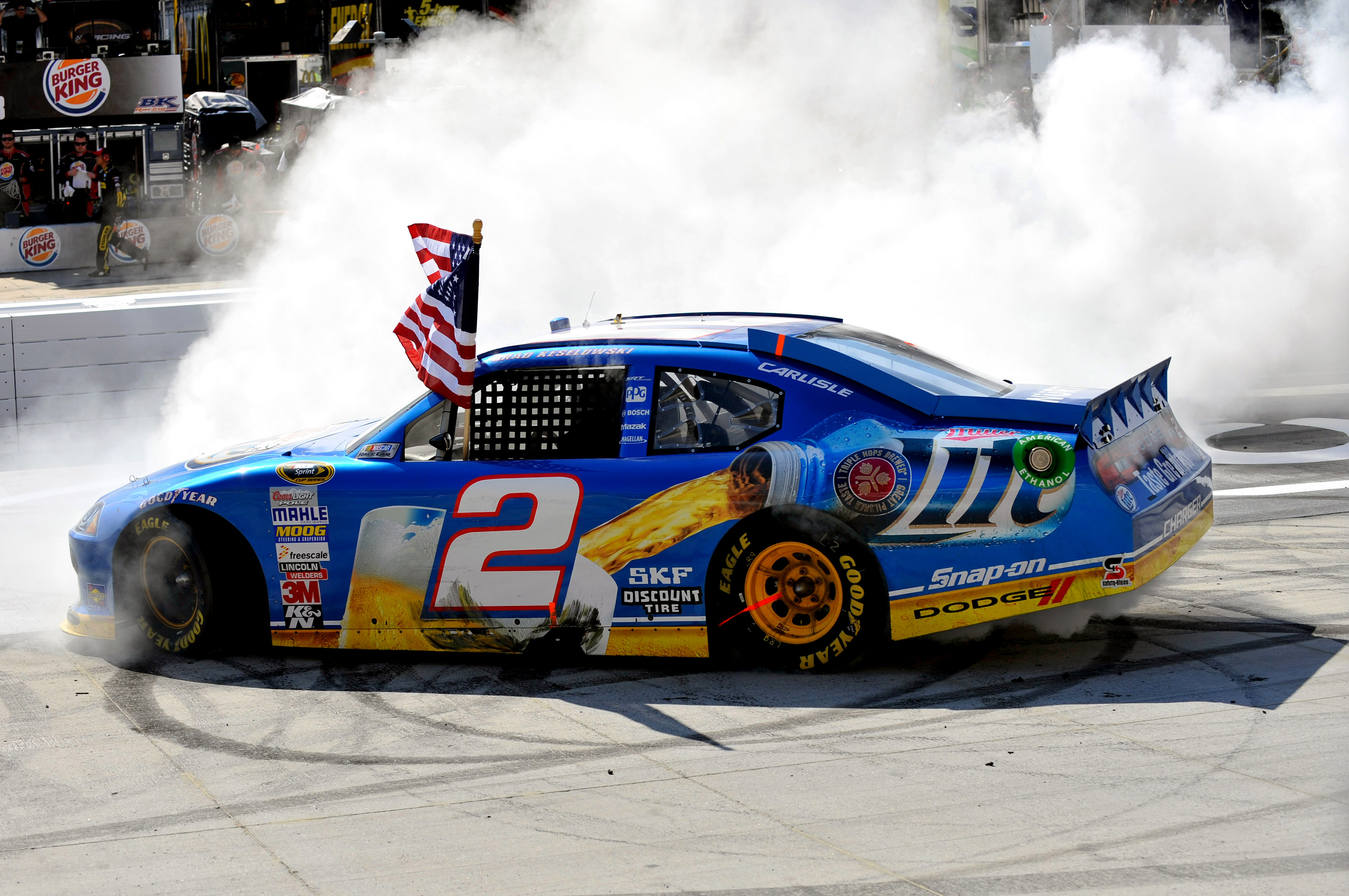
Brad Keselowski, No. 2 Miller Lite Dodge Charger, celebrates with a victory burnout after winning Sunday’s NASCAR Sprint Cup Series Food City 500 at Bristol Motor Speedway.
“We’ve spent an intense five months working to identify and evaluate all options for our future involvement in NASCAR,” Gilles said. “A number of opportunities emerged, and our team worked diligently to put a structure together to fit our overall business and competitive objectives. While we have been pleased and enthused with the amount of interest from teams and sponsors over that time, in the end, we simply couldn’t develop the right structure.”
Dodge has recorded 215 wins in the Sprint Cup Series, including 55 since 2001, and has been represented in the NASCAR Chase for the Sprint Cup seven of the eight seasons. In 2010, Brad Keselowski captured the NASCAR Nationwide Series championship in a Dodge from Penske Racing.
“It’s an extremely difficult decision to know that we won’t be there for our fans next season,” Gilles added. “It’s important to note that we have not lost focus on 2012 or the commitment to our partnership with Penske Racing in both the Sprint Cup Series and Nationwide Series this season.”
Brad Keselowski currently is seventh in the Sprint Cup Series standings and has three wins in his quest to make the 12-driver Chase field for the second consecutive year. In Nationwide Series competition, Sam Hornish Jr. is locked in a four-way battle for the season championship.