We have been providing excellent customer service for over 19 years and you are the reason we are still in business!Please call ahead and come by to visit us at one of our convenient locations in Durham, Hillsborough, or Roxboro! You are our top priority!
"It's not finding the right car what really matters anymore, it's finding the right Dealer". Welcome to CBS Quality Cars Mitsubishi
Dubai remains a city known for its wealth; built off the back of the oil industry, it now flourishes in tourism, real estate, and financial services. All that cash floating around evidently means one thing: lawbreakers drive highly expensive, fast cars. So, in response, the Dubai Police Department added an even faster car to its fleet – a 700-hp Lamborghini Aventador.
News surfaced of the acquirement on Twitter, with tweets stating “Only in Dubai” and “Officer, please cuff me in the Aventador and throw away the keys.” Additional sports cars are set to join the fleet too, with machines being designed according to police specifications in an effort to “facilitate policing on highways.”
Here in the U.S., we now focus on fuel efficiency from our cop cars rather than brute strength; philosophies between the two countries couldn’t differ more wildly. A recent study of several Ontario, Canada based police departments found the “average police car spends two-thirds of a 10-hour shift idling.” That translates to more than six gallons of fuel wasted over two shifts each day. Imagine how much fuel the Aventador will burn. Dubai has been burning through oil quickly enough as it is.
No word on which lucky Dubai cop gets to pilot the beastly machine, nor if they require special driver training. One thing's for sure, if we introduced a 217 mph Lamborghini into the U.S. police fleets, applications to become a cop would be at an all-time high.
Automakers are racing to make driving less distracting for those who want to stay.
Automakers including Chrysler, BMW and General Motors are racing to make driving less distracting for those who want to text, e-mail and even check social media behind the wheel.
"Integrating certain apps into a vehicle limits eyes off the road and will remove the temptation to hold, look and manipulate the phone," says Tom Baloga, the recently retired engineering VP at BMW. TEXTING IN TRAFFIC: Adults worse than teens
Among automakers' text/voice initiatives:
Several Chrysler models, including the Dodge Dart, can turn text to voice or allow drivers to read messages on dashboard screens. Drivers can respond with a few select responses, such as "I'm on my way," says spokesman Eric Mayne. Some vehicles with higher end radios, including the Jeep Grand Cherokee and Dodge Ram 1500 pickup, can send more "free form cloud-based text messages," Mayne says.
GM announced last month that 2013 Chevrolet Sonic and Spark vehicles with the Chevrolet MyLink communications system can translate voice to text and text to voice for drivers with compatible iPhones with iOS 6. The company also plans to add 4G LTE WiFi in some 2015 models but hasn't announced what commands will be voice-enabled.
When phones are paired with BMWs, drivers can get e-mail messages on dashboard screens that are limited to three lines. Text-to-speech will read the whole e-mail back. BMW's 7-series has a dictation function that turns speech into text that can be forwarded by e-mail or text.
Audi, which uses voice recognition for "points of interest" and full street addresses, is working on voice-enabled features that will allow drivers to send or receive text messages or use social networks in the car "without having to handle a device," says Anupam Malhotra, Audi of America's manager of connected cars.
Focus group research by the Alliance of Automobile Manufacturers late last year found that 90% of drivers with smartphones keep them in their hand, lap, cup holder or on the passenger seat.
"So, clearly, having access is really important to them," says Alliance spokesman Wade Newton.
Nearly three quarters of respondents also said the government shouldn't ban the use of hands-free, voice activated phone systems. If the government did ban these systems, almost half of those with smartphones said they'd use their phone or GPS device instead.
"Voice operation can allow them to do it in a way that's safer than it would be to have them behind the wheel fumbling around with something they bought at an electronics store; and was never even designed to be used in a car," Newton says.
Baloga agrees: "Lack of cup holders doesn't separate drivers from their coffee. Expecting all drivers to endure smartphone withdrawal is unrealistic."
But some safety advocates warn that the new technology may not solve the problem.
The safety benefits — or detriments — of these technologies are still largely unknown, says David Strayer, a University of Utah psychology professor who has studied in-car technology and distraction for about a decade. AAA and Strayer are working on new research due in June that measures how mentally distracting in-vehicle communication use is while driving.
"We've seen there is all this functionality put into vehicles, but what we don't know is if it is an activity that is or isn't safe," says Strayer. "There hasn't really been any formal analysis of the efficacy of these kinds of technologies."
Clay Skelton, inventor of a system that won't allow a car to be started unless cell phones are in a docking station, cites a study by Virginia Tech Transportation Institute researchers that concluded the riskiest behaviors with cell phones are "texting, typing, reading, dialing and reaching for a phone." Technology such as his OrigoSafe and voice to text "takes away the dangerous visual and manual" distractions, Skelton says.
First installed in London by a railway engineer in 1868, traffic lights are used in just about every city on the planet today. In the most basic sense, drivers have learned that red means stop, green light means go and that yellow indicates that caution is due as the signal is in the process of change. Even an elementary school child understands that traffic flows through a green and yellow light, but running a red light is not only dangerous, but it is against the law.
Yet China has now rewritten the rules.
On January 1, 2013, it became illegal to drive through both red and yellow lights in the Asian country. Those cited more than once will likely lose their driving privileges. The aggressive rule follows a crackdown by Chinese authorities aimed at reducing the estimated 250,000 road traffic fatalities the country experiences each year – a figure that makes road accidents the leading cause of death among residents between the ages of 15 and 44, says the World Health Organization.
The physics behind the law are flawed, as many in China have already criticized, as it is impossible to legally stop for a light without knowing when the signal is going to change. Many argue that the new regulation will grind traffic to a halt, as drivers are scared to proceed through even green lights. Despite the controversy, China's Ministry of Public Security continues to defend its odd ruling.
If there is a lesson to this story, it is that persistence can pay off -- even if it takes 42 years.
That's how long it took for Bob Russell of Southlake, Texas, to track down his stolen 1967 Austin-Healey 3000. The Dallas Morning News reports that it had been stolen from a Philadelphia apartment complex.
Now he has it back after finding it in a listing on eBay. He had been scouring the online auction site and eyeing every Austin-Healey he saw on the road.
Things were looking pretty grim for Russell, 66, a retired sales manager, when it came to the search until he got his big break. That came when he found the car listed for sale online, being sold in California by a dealer called the Beverly Hills Car Club. Even then, getting the car back wasn't easy.
Russell didn't have the stolen-car report from 1970. But he did have the key and a copy of the car title. Detectives were unable to help him at first because they couldn't find the report, either. But it was located after it was determined that a digit was off when the report was entered into the computer system.
Eventually the issues were settled, and Russell came to California to claim it. How much is it worth, besides sentimental value? The last bid on eBay was $19,700.
NEW YORK (CNNMoney) -- Google's self-driving car got its license this week as the state of Nevada became the first in the nation to license the company's vehicles.
And while a computer-driven car may seem unsettling, the technology represents a potential leap forward in auto safety.
More than 30,000 people are killed each year in crashes despite huge advances in auto safety. The overwhelming majority of those crashes are caused by human-driver error.
Computer driven cars could reduce traffic deaths by a very significant degree, said David Champion, head of auto testing at Consumer Reports, but only if all cars are computer-driven.
"I think if all the cars were self-driving, it would be a benefit," he said. "I think a mixture would be a bit chaotic."
That's because humans are better at predicting the behavior of other humans than computers could ever be, he said.
"When I'm approaching an intersection, I look to see of the other driver is looking at me," said Champion. "If he's looking somewhere else and inching forward, I'm going to lift off the gas."
For the foreseeable future, human "drivers" will continue to bear the ultimate responsibility even in Google' (GOOG, Fortune 500)s self-driving cars. This means you won't be able to lounge in the back seat and check email on your way to work. You'll still have to sit in the driver's seat and pay attention.
Self-driving cars, like Google's, use sensors to watch cars, pedestrians and other obstacles. They combine a number of technologies that are already available on cars today -- including GPS tracking, wheel motion sensors and radar -- with additional technology and sophisticated software that allow the car to read street signs and signals and actually drive itself through traffic.
Google's cars, modified Toyota Priuses, are still in the testing stages and aren't available to the public. But some so-called "driver assistance" technologies are already helping to lower traffic deaths in cars you can buy now.
Electronic Stability Control which uses computers to help drivers maintain control during abrupt maneuvers, has been shown to reduce fatal crashes by as much as a third.
ESC is now required on all new cars but was first used, on a wide scale, on SUVs. That's why, last year, statistics showed top-heavy SUVs to be less prone to roll over in real-world crashes than regular cars.
Beyond that, there are various other "driver assistance" technologies.
Blind spot alerts warn drivers of cars in adjacent lanes and forward collision alerts sound an alarm when a driver is closing in too quickly on a car ahead.
"We'll start seeing more features that will migrate from just these alerts and warnings to taking a little more control," said John Capp, director of active safety technology at General Motors (GM, Fortune 500).
GM's new Cadillac XTS, for instance, will brake automatically if a driver fails to respond to an imminent collision. Nissan's (NSANY) Infiniti division has a several models that provide slight braking to nudge a vehicle back into its lane if it begins to drift out.
Many luxury cars are now also available with "active cruise control" that allows a car driving at highway cruising speeds to automatically maintain a safe following distance behind the car ahead. In some models, these systems can work even in stop-and-go city traffic.
Systems like these could be helpful, said Champion, but also present the possibility of over-reliance or abuse.
"It all comes down to the person behind the wheel using the system," he said.
Sometimes these systems can cause confusion. For instance, some reports of unintended acceleration in Toyota cars were triggered by drivers failing to understand how an "active cruise control" system worked.
With these systems, drivers set the active cruise control to a certain speed. If there's a slower car ahead, the cruise control will automatically slow the vehicle down to maintain a safe distance between the two cars. Once the slower car moves away, active cruise control will accelerate to the higher preset speed. This acceleration can be startling to drivers unfamiliar with the system.
There is at least some evidence, however, that "driver assistance technologies" do work. A recent study by the Highway Loss Data Institute, an insurance industry group, indicated that the forward collision avoidance system in the Volvo XC60 helped reduced accident claims by 27%. Volvo's system warns the driver of an impending collision and applies the brakes if the driver takes no action.
One technology the Google car doesn't utilize, but which would help make self-driving cars much more effective, Champion said, is vehicle-to-vehicle communication. So called V2V communication uses transmitters to send and receive signals that tell other cars where each car is, where it's headed and how fast it's moving. The devices can also communicate with transmitters along the road.
V2V is already in advanced stages of development by a consortium of automakers and the federal government's National Highway Traffic Safety Administration
Orlando, Fla. —Rennie Bryant has seen it all before: Since founding Redline Performance, an auto repair facility in Pompano Beach, Fla., more than 35 years ago, he's used to hearing last-minute requests from customers who are heading out of town on a holiday trip.
They're looking for a quick, last-minute checkup to make sure their car, truck, SUV or minivan is up to the trip. And sometimes, when Bryant asks when they plan to leave, the answer is, "This afternoon."
Of course, that is probably too late. The holiday season will be here before you, and your car, know it. Holiday travel is stressful enough, and an ill-prepared vehicle can not only jeopardize your trip but the safety of you and your passengers. And even in the best case, on-the-road repairs are seldom cheap or convenient.
There's a lot that shade-tree mechanics can do, but Bryant suggests that to really check the car out, you need to put the vehicle on a lift, and few of us have access to one. Underneath, Bryant said that while modern vehicles don't need conventional lubrication jobs, you need to check CV joint boots — rubber enclosures that surround constant-velocity joints on front and all-wheel-drive vehicles that connect the engine to the wheels — for cracks that can let lubrication out, dirt and water in.
It's also much easier to check for leaks from underneath. You can catch small problems before they turn into big ones. Brakes and brake lines should be inspected, as well as the condition of the exhaust system.
"It's easier to check tires, too," Bryant says, as you can rotate the tire and check all the tread for cuts, unusual wear or nails and other puncture-causing objects.
Once the car is back on the ground, Bryant checks the spare tire. "No one ever thinks to look at it and check the pressure until it's too late," he says. "Those little temporary spare tires tend to lose air quickly."
Under the hood, Bryant checks the age, level and condition of the oil, the transmission fluid and the brake fluid. "And, of course, the antifreeze in the radiator."
Also worth a look: Belts and hoses; fuel, oil and air filters (including the often-overlooked cabin air filters many modern vehicles have), and windshield washer fluid, as well as the condition of the wipers. When was the last time you checked to make sure all your exterior lights work? A pre-holiday trip checkup is a good time.
Finally, don't forget your own comfort on a trip. A good interior cleaning, including the glass, will make the trip more pleasant — no car ever comes back from a holiday trip cleaner than it was when you left.
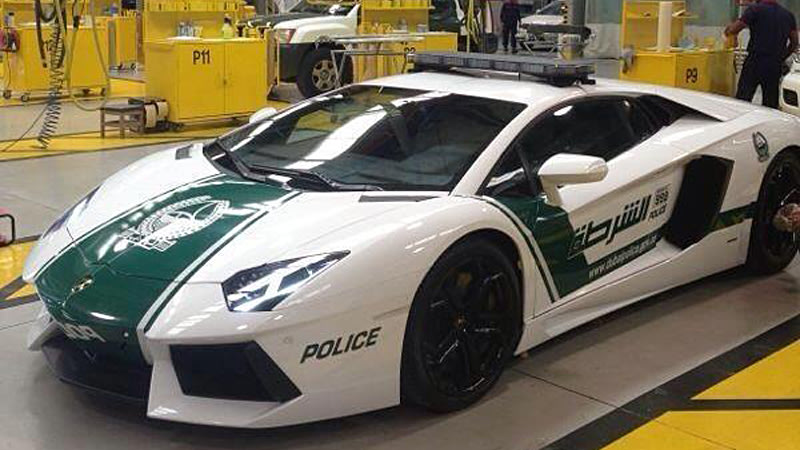 Dubai remains a city known for its wealth; built off the back of the oil industry, it now flourishes in tourism, real estate, and financial services. All that cash floating around evidently means one thing: lawbreakers drive highly expensive, fast cars. So, in response, the Dubai Police Department added an even faster car to its fleet – a 700-hp Lamborghini Aventador.


